
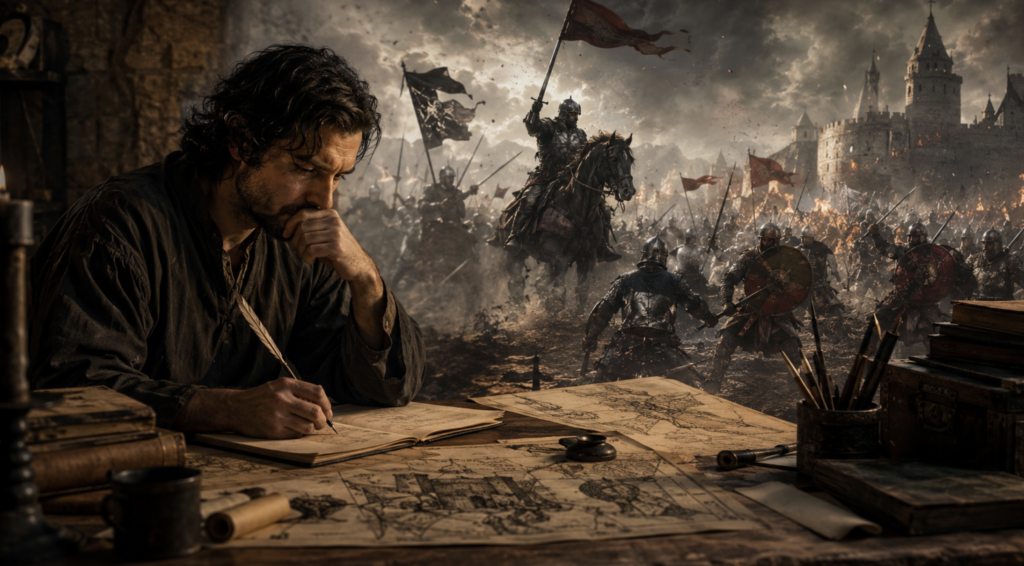
A fantasy battle scene should never feel like a random storm of swords, arrows, fire, blood, and shouting. It should feel like a turning point. The best fantasy battles do more than fill pages with movement. They reveal character, test loyalty, expose fear, change the direction of the story, and leave the reader feeling like something important has shifted. That is why learning how to write a battle scene in fantasy step by step matters so much for authors who want their stories to feel powerful, cinematic, and emotionally real.
Many writers think a battle scene has to be huge to be exciting. That is not always true. A fight between two exhausted warriors in a candlelit corridor can be just as gripping as a war between kingdoms. The size of the battle matters less than the clarity, stakes, emotion, and consequence behind it. If the reader does not understand who is fighting, why they are fighting, what could be lost, and what changes afterward, the battle can feel noisy instead of meaningful.
Before writing the scene, it helps to understand that conflict is one of the core engines of storytelling. Wikipedia’s overview of narrative conflict explains how opposing forces create tension and delay a character from reaching a goal. In fantasy, battle scenes often make that conflict visible. The hidden betrayal becomes a siege. The moral dilemma becomes a duel. The kingdom’s political tension becomes a battlefield covered in banners, smoke, and broken shields.
This guide will walk through how to write battle scenes in a way that is clear, emotional, and useful to the story. Instead of simply describing weapons and wounds, you will learn how to build the scene from purpose, point of view, setting, movement, emotion, magic, pacing, and aftermath.
Start with the Story Purpose Behind the Battle
The first step in writing a strong fantasy battle scene is deciding why the battle belongs in the story. A battle should not exist only because fantasy readers expect one. It should serve the plot. It should force a decision, reveal a truth, change a relationship, remove a false sense of safety, or push the hero into a new stage of growth.
Before writing the first strike, decide what the scene is supposed to accomplish. The battle might show that the enemy is stronger than anyone believed. It might prove that the hero is brave but reckless. It might separate allies, kill a mentor, expose a traitor, or force a character to use forbidden magic. When the purpose is clear, every moment in the battle can work toward that result.
This is one of the most important parts of how to write battle scenes because the reader needs more than action. They need direction. A battle without purpose becomes a blur. A battle with purpose becomes a story event. The difference is not in how many soldiers appear on the page, but in how deeply the battle changes the characters and the world around them.
For example, if a young prince enters battle believing glory is beautiful, the scene should challenge that belief. He might see loyal soldiers crushed in the mud. He might freeze when someone calls for help. He might survive, but only because someone else sacrifices everything. By the end, the battle has done more than entertain. It has changed the prince.
Know the Stakes Before the First Sword Is Drawn
A battle scene needs stakes before it needs choreography. The reader should understand what can be won, what can be lost, and why the outcome matters. The stakes can be physical, emotional, political, spiritual, or personal. In fantasy, they are often several of these at once.
Physical stakes are clear. Someone may die. A city may fall. A fortress may burn. Emotional stakes are often more powerful. A character may lose faith in a friend. A warrior may discover that courage does not erase fear. A queen may have to choose between saving her child and saving her people. Political stakes raise the scale. If the army loses, the throne falls. If the gate breaks, an empire ends. Spiritual or magical stakes can add another layer, especially when gods, curses, ancient relics, or forbidden powers are involved.
When learning how to write battle scenes, think about what the reader is supposed to fear. If the battle could go either way, the tension rises. If the hero can win too easily, the scene loses power. The best fantasy battles make victory costly. Even when the heroes win, something should be lost, broken, or changed.
A strong way to sharpen stakes is to tie the battle to a specific character desire. The soldier wants to get home to his daughter. The mage wants to prove she can control her power. The knight wants forgiveness from the commander he betrayed. These personal stakes make the large battle feel intimate.
Choose the Right Point of View
Point of view controls how the battle feels. A wide, distant viewpoint can show strategy, troop movement, and the scale of war. A close viewpoint can show panic, pain, confusion, and personal courage. Most fantasy battle scenes work best when the writer stays close to one character at a time, even if the battle itself is massive.
Purdue OWL’s Fiction Writing Basics offers helpful guidance on core fiction techniques, including character development and story construction. Those fundamentals matter in battle scenes because action is strongest when filtered through a character the reader understands. The battle is not just happening on the field. It is happening inside the character’s body and mind.
A close point of view lets the reader experience what the character can see, hear, smell, and understand in the moment. The character may not know the left flank has collapsed. They may only hear the horn blast, see men turning, and realize something has gone terribly wrong. That limited awareness can create tension and realism.
This is a key part of how to write battle scenes because clarity does not mean explaining everything. It means showing the right details from the right perspective. If the scene is from the viewpoint of an archer on the wall, the reader should experience distance, aim, wind, trembling fingers, and the horror of watching enemies climb closer. If the scene is from a commander’s viewpoint, the reader should experience maps, signals, timing, and the terrible weight of sending people to die.
Build the Battlefield Before the Fighting Begins
A good battle scene needs a physical layout. The writer should know where the characters are, where the danger comes from, what obstacles exist, and how the terrain affects the fight. The reader does not need a military diagram, but the writer should have one in mind.
A battlefield can be a castle courtyard, a forest road, a mountain pass, a frozen lake, a ruined temple, a narrow bridge, or a city street. Each setting creates different possibilities. A forest limits visibility. A bridge creates a bottleneck. A swamp slows armor. A rooftop fight adds falling danger. A temple filled with ancient statues can create cover, symbolism, and destruction.
The Writer’s Digest guide on writing battle scenes discusses the usefulness of mapping a battle so the writer understands where forces begin, move, and end. This matters because confusion on the writer’s side often becomes confusion for the reader. A simple private map can help you track gates, towers, rivers, roads, ridges, trenches, magical barriers, and escape paths.
When considering how to write battle scenes, remember that setting should not sit in the background like decoration. The battlefield should shape the action. Rain can turn dirt into sucking mud. Smoke can hide an enemy charge. Loose stone can make a duel dangerous. A burning bridge can force the hero to make a brutal choice. The more the setting affects the fight, the more alive the scene feels.
Plan the Flow of the Battle in Clear Stages
A fantasy battle should have movement, escalation, and turns. It should not be one long paragraph of people clashing. Think of the battle in stages. The first stage may be anticipation. The second may be the opening attack. The third may be confusion. The fourth may be a reversal. The fifth may be the desperate final move. The last may be silence, retreat, victory, or ruin.
This structure gives the reader a sense of progression. At the beginning, the army waits under black clouds while horns sound beyond the ridge. Then arrows fall. Then the gate cracks. Then the hidden cavalry appears. Then the mage loses control of the spell. Then the hero makes a choice that changes the outcome.
Learning how to write battle scenes means learning how to control escalation. The battle should grow more intense as it unfolds. Early action can be sharp but manageable. Later action should become harder, more personal, and more costly. The reader should feel that the situation is getting worse, not staying at the same level of danger.
Clear stages also help with pacing. If every sentence is frantic, the reader becomes numb. A powerful battle scene needs pressure, release, renewed pressure, and consequence. A moment of silence before a charge can be more frightening than the charge itself. A wounded friend whispering one sentence can hit harder than three pages of sword strikes.
Keep the Action Clear and Concrete
One of the biggest mistakes in fantasy battle writing is vague action. Phrases like “chaos erupted,” “they fought fiercely,” or “the battle raged” can be useful in small amounts, but they do not give the reader a clear image. Strong battle writing uses concrete details.
Instead of saying the soldiers fought hard, show a shield splitting under an axe. Show a horse screaming as it falls. Show a spear scraping sparks against a stone wall. Show the hero’s hand going numb from the force of a blocked strike. Show the banner disappearing in smoke.
MasterClass offers practical advice on action scenes, including the idea that fight scenes should fit the larger story and use enough technical detail without overwhelming the reader. That balance is important. Too little detail makes the scene feel generic. Too much detail makes it read like stage directions.
This is especially important in how to write battle scenes because readers need to follow the action without feeling trapped in a blow-by-blow manual. You do not need to describe every swing, parry, step, and wound. Choose the details that reveal danger, character, and consequence. A single broken tooth may say more than five sword exchanges.
Concrete writing also helps with emotional impact. “He was scared” is weaker than “his mouth dried so fast he could not swallow.” “The army was losing” is weaker than “the king’s blue banners vanished one by one behind the smoke.” Specific images make the battle memorable.
Use Emotion to Anchor the Reader
Battle scenes become powerful when the reader feels what the character feels. Fear, rage, guilt, shock, courage, grief, and determination should run beneath the physical action. The character should not become a machine once the fighting starts.
A seasoned warrior may feel calm at first, then panic when a young recruit dies because of his order. A healer may freeze when the wounded outnumber the living. A mage may feel the thrill of power and then horror when the spell spreads beyond control. A farm boy holding a spear may discover that bravery feels exactly like terror, except his feet keep moving.
This is where how to write battle scenes becomes more than choreography. The battle should reveal the character’s inner life. What do they notice first? What do they ignore? Who do they protect? What line will they cross? What memory comes back at the worst possible moment?
Emotion also gives variety to the scene. A battle made only of violence can feel flat. A battle filled with emotional shifts feels human. The hero may begin with confidence, fall into fear, rise into courage, and end in grief. That emotional movement gives the scene shape.
Make Magic Powerful but Limited
Fantasy battles often include magic, and magic can make a battle unforgettable. Firestorms, summoned beasts, enchanted armor, cursed blades, healing songs, shadow gates, and divine weapons can raise the scale far beyond ordinary combat. Yet magic needs limits. If magic can solve everything instantly, the battle loses tension.
The rules of magic should affect the fight. A spell may require time, blood, language, a rare ingredient, emotional control, or a physical cost. A mage may be powerful from a distance but helpless if an enemy gets close. A healing spell may save one person while three others die. A dragon may destroy a battlefield but refuse to obey unless an ancient oath is spoken.
Writer’s Digest also has guidance on writing fight scenes with magic, which is useful for fantasy authors who want magical combat to feel believable inside the rules of the story. The more consistent the limits are, the more satisfying the battle becomes.
When thinking about how to write battle scenes with magic, focus on cost and consequence. Magic should create choices, not shortcuts. A character who uses forbidden power may win the battle but lose trust. A spell may save the castle but poison the land. A magical weapon may defeat the enemy but awaken something worse.
Balance Large-Scale War with Personal Moments
Epic fantasy often deals with armies, kingdoms, monsters, and ancient powers. Still, the reader connects most deeply through personal moments. A battle scene can show thousands of soldiers, but it should also give the reader a face, a voice, a hand reaching through smoke.
A commander watching formations collapse can be powerful. So can a single soldier trying to drag his wounded brother away from the gate. A queen giving the order to fire on her own wall can be powerful. So can the archer who knows that order will kill people she loves. Large-scale battles become meaningful when they are filtered through personal experience.
This is central to how to write battle scenes that do not feel cold. The reader may care about the fate of a kingdom, but they will usually care more when that kingdom is represented by a character they know. The fall of a city becomes sharper when the baker who once fed the hero is standing at the barricade with a kitchen knife.
Personal moments also create contrast. The roar of battle followed by one intimate detail can be devastating. A child’s toy crushed in the mud. A familiar song cut short. A knight recognizing the enemy beneath a broken helmet. These details bring the epic scale down to the human level.
Use Pacing to Control Intensity
Pacing is one of the most important tools in a battle scene. Shorter sentences can create speed and urgency. Longer sentences can create dread, confusion, or exhaustion. Paragraph length, sentence rhythm, and detail selection all affect how the battle feels.
During fast action, use direct sentences. Let the reader feel impact. During a moment of dread, slow the pace. Let the character notice the enemy line forming, the silence before the horn, the sweat under armor, the trembling horse. During exhaustion, let the prose feel heavier. Let the character struggle to lift the sword, breathe through smoke, and remember why standing still means death.
The Writing Excuses archive on fight scenes offers useful discussions on confrontation, action, physicality, and character motivation. Those elements matter because a battle is not only what bodies do. It is also what characters decide under pressure.
Pacing helps when learning how to write battle scenes because the reader needs rhythm. Constant speed becomes exhausting. Constant description becomes slow. A strong battle scene moves like waves: approach, impact, recoil, regroup, and strike again.
Show Consequences After the Battle Ends
A battle does not truly end when the last enemy falls. It ends when the characters face what the battle has done. The aftermath may be quiet, but it is often where the emotional weight lands.
After the battle, show the cost. The field may be silent except for rain and wounded voices. The hero may find the person they failed to save. The commander may walk through the surviving troops and realize half the banners are gone. The mage may see the damage caused by their own spell. Victory may taste like ash.
This final step is vital in how to write battle scenes because consequences prove that the scene mattered. If everyone walks away unchanged, the battle feels temporary. If the world changes afterward, the reader understands that the scene had weight.
The aftermath can also set up the next part of the story. A captured enemy may reveal a larger threat. A broken sword may become a symbol of failure. A funeral may turn allies against each other. A victory may create political danger. A wound may carry a curse. The battle should leave marks on the plot, the characters, and the world.
Conclusion
Learning how to write a battle scene in fantasy step by step is really learning how to combine action with meaning. A battle should have a clear purpose, strong stakes, a focused point of view, a vivid battlefield, a logical flow, concrete action, emotional depth, consistent magic, careful pacing, and lasting consequences.
The best fantasy battles are not remembered only because they are violent or large. They are remembered because they change something. A hero loses innocence. A kingdom falls. A friendship breaks. A hidden power awakens. A victory costs more than anyone expected. When the battle changes the story, the reader feels the impact long after the swords are lowered.
If you want to master how to write battle scenes, do not begin with the weapons. Begin with the reason the battle matters. Then build every strike, scream, spell, and sacrifice around that purpose. That is how a fantasy battle becomes more than action. It becomes a turning point the reader cannot forget.