
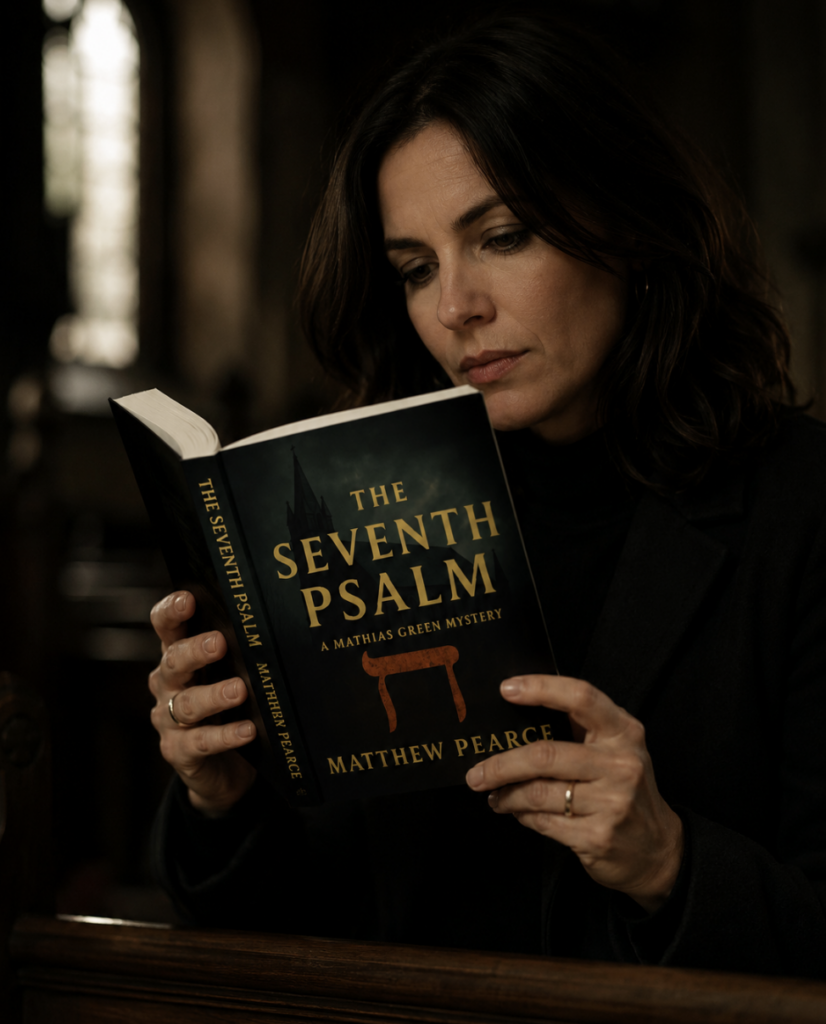
Mystery readers are not just looking for a crime. They are looking for a question that keeps tightening, a trail of clues that feels meaningful, and a story that rewards attention. That is why The Seventh Psalm by Matthew Pearce stands out for readers who want something deeper than a simple whodunit. It blends ritualistic murder, theological symbolism, criminal profiling, and psychological tension into a dark mystery that feels both cinematic and intellectual. For readers searching for the best mystery books, this is the kind of story that gives the genre its lasting power. 🔎
The novel follows Dr. Mathias Green, a former divinity scholar turned criminal profiler, after a series of ritualistic murders strike New York City. Each crime is staged with chilling religious precision, and the killer, known only as Psalmist13, appears to be using scripture as both a message and a weapon. That premise immediately gives the book a gripping foundation. It is not only about catching a murderer. It is about understanding why the killer sees murder as doctrine, prophecy, and performance.
A Mystery Built on More Than the Crime
The strongest mysteries are never built on the body alone. They are built on the unanswered question behind the body. The Seventh Psalm understands that. Its murders are disturbing, but the true hook is the meaning behind them. Every staged scene points toward a deeper pattern, and every clue forces Mathias to examine not only the killer’s mind, but also his own past.
That layered approach is one reason the book belongs in conversations about the best mystery books for readers who want intelligence with their suspense. The story uses the familiar tools of crime fiction—murder, investigation, suspects, clues, and danger—but it gives those tools a philosophical edge. Readers are not simply watching police chase a criminal. They are watching a battle of interpretation, where scripture, memory, guilt, and logic all become part of the investigation.
This is also where The Seventh Psalm fits naturally within the long tradition of detective fiction. The genre has always been about more than solving a puzzle. It has been about restoring order from chaos. In this novel, that chaos is spiritual, intellectual, and emotional, which makes the investigation feel larger than a case file.
A Dark Thriller for Readers Who Like Their Suspense With Depth
Some mystery novels move quickly but leave little behind once the final page turns. The Seventh Psalm offers something heavier. It has the pace and tension readers expect from a dark thriller, but it also carries the weight of belief, obsession, and consequence. The crimes are not random. They are structured. They are staged. They are meant to be read.
That is important because readers who love the best mystery books often want a story that challenges them. They want to feel the pressure of the investigation, but they also want to think. The Seventh Psalm gives them both. The darkness in the book does not exist for shock value alone. It creates atmosphere, raises moral questions, and pushes the protagonist into places he would rather avoid.
Mathias Green is especially effective because he is not a flawless genius dropped into a crime scene. He is a man with knowledge, pain, and blind spots. His background as a former divinity scholar gives him insight into the killer’s symbolic language, but it also makes the case dangerously personal. The more he understands, the more he realizes the murders may connect to ideas he once taught and a legacy he thought he had left behind.
The Power of a Complex Lead Character
A great mystery needs a lead character who can carry more than the plot. Mathias Green does that by giving readers a protagonist who is brilliant, haunted, and uncertain in all the right ways. His knowledge makes him valuable to the NYPD, but his past makes him vulnerable. That tension creates a strong emotional center for the story.
In many of the best mystery books, the investigator is not only solving the case; the case is also exposing the investigator. That is exactly what happens here. Mathias is pulled deeper into a twisted game of scripture and symbolism, and each revelation forces him closer to the parts of himself he has tried not to examine. That internal pressure gives the novel a richer shape.
The supporting characters also help ground the story. NYPD Captain Julia Halpern brings a no-nonsense law enforcement presence, while tech analyst Lennox Rivera adds a modern investigative angle. Together, they create a balance between old knowledge and new tools, between ancient texts and digital evidence, between instinct and analysis. That combination gives the book a contemporary feel while keeping the mystery rooted in timeless questions.
Why Symbolism Makes the Story More Memorable
Symbolism can make a mystery unforgettable when it is handled well. The Seventh Psalm uses theological imagery not as decoration, but as part of the criminal language of the story. Psalmist13 is not merely leaving clues. He is creating scenes that demand interpretation. That makes every murder feel like a message, and every message brings Mathias closer to a truth that may be more personal than he expects.
This kind of structure is appealing to readers who follow crime and thriller coverage from respected sources like Publishers Weekly’s mystery and thriller reviews, where books are often evaluated not just by plot, but by voice, pacing, character, and originality. The Seventh Psalm has the kind of premise that catches attention because it does not rely on a basic chase. It gives the killer a disturbing worldview and asks the reader to follow the logic without being consumed by it.
That is one reason it can stand among the best mystery books for readers who love puzzles with atmosphere. The mystery is not only about who Psalmist13 is. It is about what the murders mean, why Mathias may be connected, and whether knowledge can become dangerous when it falls into the wrong hands.
A Story That Fits the Modern Mystery Reader
Modern mystery readers have a wide range of choices. They can find cozy mysteries, courtroom thrillers, psychological suspense, police procedurals, noir, domestic thrillers, and literary crime novels. Resources like NPR’s Books We Love and The Guardian’s crime and thrillers roundup show how broad the genre has become, with readers gravitating toward stories that mix atmosphere, emotion, and originality.
The Seventh Psalm fits that modern landscape because it combines several reader favorites. It has the investigative structure of crime fiction, the darkness of a psychological thriller, the symbolic depth of a theological mystery, and the momentum of a cinematic police case. For readers looking through lists of the best mystery books, that combination matters because it offers something familiar enough to satisfy genre expectations and fresh enough to stand apart.
The setting of New York City also adds scale. A ritualistic killer moving through a city as layered as New York creates natural tension. The city becomes more than a backdrop. It becomes a maze of public spaces, hidden histories, institutions, shadows, and buried secrets. That sense of place strengthens the atmosphere and gives the investigation room to grow.
A Thriller That Respects the Reader’s Intelligence
One of the best things about The Seventh Psalm is that it trusts the reader. It does not treat mystery as a series of cheap reveals. It builds meaning through patterns, symbols, and character pressure. The novel asks the reader to pay attention, and that creates a more satisfying experience.
Readers who enjoy the best mystery books often appreciate when a story gives them clues without overexplaining every step. The Seventh Psalm invites readers into the investigation and lets them feel the unease of trying to interpret something sinister before it is too late. That approach creates active reading. You are not just waiting for the answer. You are weighing possibilities, watching for hidden connections, and wondering how much of the killer’s message Mathias understands before the killer wants him to.
This is the kind of storytelling that gives a mystery replay value in the mind. After the last page, readers can look back at the patterns, the symbols, and the emotional turns and see how the pieces were moving all along. That makes the ending feel earned rather than manufactured.
Why Dark Mysteries Continue to Matter
Dark mysteries remain popular because they allow readers to confront fear through structure. A murder mystery begins with disorder, but it promises a search for truth. Even when the story explores disturbing themes, the act of investigation gives readers a way through the darkness. That is part of why the genre remains so durable, from classic detective stories to today’s psychological and literary thrillers.
Library and publishing outlets such as Library Journal’s mystery reviews and its coverage of crime fiction trends continue to show how much room there is for mysteries that blend traditional investigation with darker themes, genre crossover, and emotional complexity. The Seventh Psalm fits that direction because it is not content to be only one thing. It is a murder investigation, a psychological descent, a theological puzzle, and a character-driven thriller.
That layered identity is why it deserves attention from readers searching for the best mystery books with a sharper edge. It delivers suspense, but it also delivers a sense of consequence. It gives the reader a killer worth fearing, a protagonist worth following, and a mystery that feels like it is reaching into old wounds as much as new crimes.
A Strong Choice for Fans of Intelligent Suspense
If a reader wants a light mystery, The Seventh Psalm may not be the first choice. But for readers who want something darker, smarter, and more atmospheric, it has the right ingredients. It offers ritualistic murders, coded meaning, a haunted profiler, an urgent investigation, and a villain whose crimes are designed to be interpreted as much as solved.
That is what separates it from many ordinary thrillers. It does not rely only on danger. It relies on dread, curiosity, and the uneasy feeling that every clue may be pointing toward something Mathias does not want to face. For readers building a list of the best mystery books to read next, that kind of depth can make a novel feel more memorable than a standard crime story.
The best thrillers do not simply ask, “Who did it?” They ask, “What does it mean?” The Seventh Psalm asks both. It gives readers the chase, the puzzle, the darkness, and the personal reckoning that make mystery fiction so compelling.
Conclusion
The Seventh Psalm stands out because it understands what serious mystery readers want. It has a chilling premise, a layered protagonist, a dangerous killer, and a story world built on symbolism, fear, intelligence, and consequence. It is dark without feeling empty, thoughtful without becoming slow, and suspenseful without losing its deeper meaning.
For readers who love the best mystery books, The Seventh Psalm offers a thriller that feels intense, intelligent, and memorable. It belongs on the radar of anyone who enjoys crime fiction with atmosphere, theological tension, psychological depth, and a mystery that keeps tightening until the final verse is still unwritten.